
Dual actuator control with integrated DAQ
 Designed and manufactured in India
ActuatorDAQ for Stepper Motor Control, Industrial I/O, and Data Logging
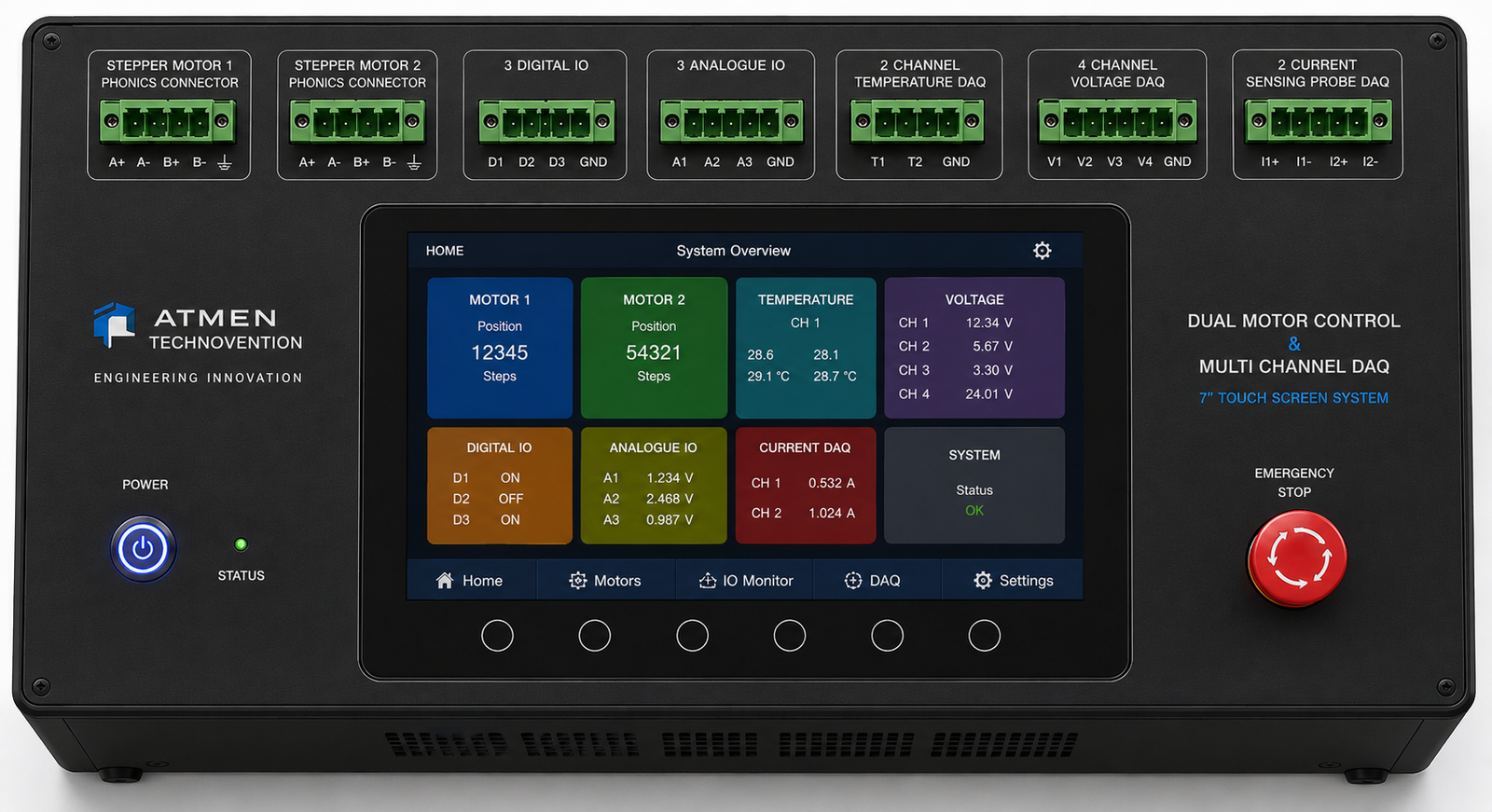
ActuatorDAQ is a compact industrial platform for independently driving two stepper motors while acquiring current, temperature, voltage, digital I/O, and analogue I/O data. It combines motion control, protective interlocks, live monitoring, trends, alarms, and USB CSV export in a tabletop instrument with a 7-inch capacitive touchscreen.
Designed and manufactured in India
System architecture
Motion control and acquisition in one enclosure
The proposed architecture separates high-energy motor power circuits from low-level measurement electronics. The embedded controller coordinates motion pulse generation, safety interlocks, touchscreen operation, acquisition, diagnostics, alarm handling, and data logging.
Dual motor control
Two independent two-phase bipolar stepper motor channels with position, velocity, jog, homing, and profile modes.
Integrated DAQ
Current, PT100 temperature, voltage, digital I/O, and analogue I/O acquisition from one synchronized platform.
Touchscreen HMI
7-inch capacitive operator interface for control, calibration, trends, alarms, recipes, and settings.
CSV logging
Timestamped USB logging for live measurements, statistics, alarm history, and engineering review.
Technical specification
Proposed engineering configuration
These values are design targets from the engineering proposal. Final guaranteed performance depends on selected motors, duty cycle, sensor ranges, isolation requirements, enclosure thermal validation, and final component selection.
- Motor channels
- 2 fully independent two-phase bipolar stepper motor control channels.
- Motor output
- 48 V DC fixed regulated motor supply with power capacity sized for simultaneous two-motor operation.
- Target current
- Up to approximately 10 A peak per channel, subject to final motor and driver selection.
- Motion modes
- Position, velocity, jog, homing, sequence/profile, forward, reverse, and configurable acceleration control.
- Current acquisition
- 2 isolated motor-current consumption channels with 0-20 A nominal range and minimum 30 A short-duration headroom recommended.
- Temperature
- 2 PT100 RTD channels with 3-wire lead compensation, 0.1 deg C practical display resolution, and sensor fault diagnostics.
- Voltage inputs
- 4 protected voltage acquisition channels, standard 0-10 V DC range with optional 0-5 V, +/-5 V, or +/-10 V configuration.
- Digital I/O
- 3 configurable industrial digital channels for home sensors, limits, interlocks, external triggers, status, or alarm outputs.
- Analogue I/O
- 3 analogue channels with 0-10 V and/or 4-20 mA input/output configuration options.
- Communications
- USB host/service with optional RS-485 Modbus RTU, CAN, and Ethernet interfaces.
- Connectors
- Removable push-lock field terminals and high-current motor connectors rated minimum 16-20 A.
- Mechanical
- Powder-coated tabletop metal enclosure with forced-air cooling and physically separated power/measurement sections.
Subsystems
Designed for controlled motion and measured feedback
Embedded controller
Hardware-timer-based pulse generation, watchdog supervision, deterministic firmware, and safe startup sequencing.
Thermal management
Temperature-controlled forced-air cooling with fan monitoring, internal temperature sensing, and protective shutdown.
Field wiring
Serviceable connector grouping for motors, digital I/O, analogue I/O, RTD, voltage, current sensor, power, and communications.
Live diagnostics
Real-time trends, min/max/average/peak statistics, channel scaling, alarm limits, and timestamped fault logging.
Safety and protection
Built-in protective control layers
Emergency stop
Hardware emergency-stop path for motor enable and/or 48 V motor power removal.
Motor protection
Per-motor overcurrent warning and shutdown thresholds with motor driver fault monitoring.
Thermal protection
Fan control, overtemperature warning, fan-failure detection, and protective shutdown strategy.
Sensor diagnostics
Open/short RTD detection, invalid voltage detection, brownout reset, and timestamped alarm history.
Dual stepper motor controller with integrated data acquisition
ActuatorDAQ is intended for motorized test benches, actuator validation, automation fixtures, production test systems, and research equipment where motion commands and sensor feedback must be captured together. The system combines actuator control, industrial I/O, current measurement, temperature acquisition, voltage monitoring, touchscreen control, trend visualization, and data logging in a single engineered platform.
Next step